England's flag is mine too
England fan Sash Patel reflects on his World Cup journey and what it means as a supporter with South Asian heritage.
I was born in England. I support England. And I am done with the idea that people who look like me have to explain why.
As a British South Asian man of Indian heritage and the son of a migrant family, I have spent much of my life understanding that for some people, my Englishness comes with an asterisk. It can be questioned, tested, treated as conditional.
This summer, I followed England from Maidenhead United’s York Road, the oldest football ground recognised by FIFA, to New York for the World Cup game against Panama. I wore the shirt. I sang the songs. I waved our flag. And in the middle of all the noise, colour and chaos of a World Cup, I kept coming back to one question: why do some people still act as if the England flag belongs to them more than it belongs to me?
Because that feeling does not come from nowhere. It comes from years of seeing Englishness presented in narrow terms. It comes from the assumption that if you are brown, or have certain features like have a beard, or don’t take part in all the chants or look “different” in any way, your support is somehow less authentic. It comes from the double takes when you turn up draped in a St George’s Cross, the social media replies telling people like you to “go home or support your real country”, or the chants and comments that turn patriotism into exclusion. It comes from knowing that for some, the flag is still used less as an invitation and more as a line in the sand.
And that is why this World Cup meant so much.
The truth is, being out in the US with England supporters gave me a glimpse of the fan culture I want football to embrace more often. In the fan parks, in bars, on the streets, there was joy everywhere. England shirts worn with pride and flags draped over shoulders from every background imaginable. Kids kicking balls around. Fans swapping chants and stories. Doing the “We are Englishmen in New York” dance with Britain’s Got Talent finalist Sonny Green in the middle of Times Square with my “Love England. Hate racism” t-shirt. Sonny’s poem about England was rooted in acceptance, unity and kindness, exactly the kind of modern Englishness this conversation needs.
There was something powerful about seeing football do what it does at its best: bring people together before anyone has had the chance to divide them.
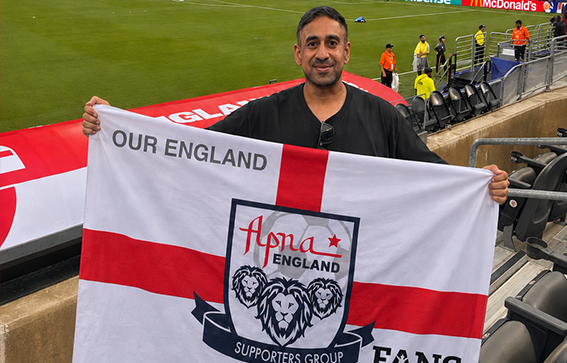
People also stopped to ask about the Apna England flag I was carrying.
It’s ours. That’s what “Apna” means. Ours. England is ours too. The shirt is ours too. The flag is ours too. It belongs to everyone.
Apna England is a supporters’ group created to celebrate and connect England fans of South Asian heritage and to make clear that we belong in these spaces too. There was something powerful about seeing football do what it does at its best: bring people together before anyone has had the chance to divide them.
Then came matchday.
Walking up to the stadium, talking to strangers, carrying a flag that also carried the logos of Kick It Out and the Football Supporters’ Association, I felt proud. Proud of the journey. Proud I was representing my country. Proud to be an England supporter with South Asian heritage who was not on the outside looking in, but right there in the middle of the World Cup, taking up space, backing England, being visible.
And once I was inside, that feeling only intensified.
The noise, the anticipation, the sea of England shirts, the sense that for 90 minutes thousands of strangers were bound together by the same hope… that hit me all at once. When England scored, I celebrated like everyone else… jumping, shouting, hugging the people around me, that split second of disbelief turning into release. It was pure joy. The kind of joy football gives you when you stop thinking and just feel. In those moments, there is no asterisk. No explanation. No permission needed. Just belonging.
What stayed with me too was seeing other fans who looked like me. South Asian supporters. Families. Fans from different communities travelling across continents to follow England. That visibility matters. It matters because too often the image of an “England fan” is still imagined far too narrowly. But we are here. We have always been here. Not as guests. Not as a side note. As part of England’s support, part of its story, part of its future.
My belief in inclusion and diversity does not begin with fatherhood. It did not suddenly arrive when I had children. It comes from lived experience. It comes from growing up in football spaces where you quickly learn who is seen as “normal” and who is made to feel like they are on the outside looking in. It comes from loving a game that has not always loved everyone back.
It is also why I do the work I do. Through my role as a Board Director at the Football Supporters’ Association and non-Executive Director at Her Game Too, my work with Tottenham Hotspur’s Fan Advisory Board, co-founding and co-chairing Spurs REACH, and being part of Apna England, I have seen how powerful football can be when it opens its doors properly and how damaging it is when it still asks some supporters to prove they belong.
Because South Asian fans are not a footnote in English football. We are part of its fabric.
That is why South Asian Heritage Month matters, and why this year’s theme, Unity in Diversity, should challenge football, not just flatter it. It should force us to ask why Englishness still feels easier for some fans to claim than others.
At the Panama game, I held an England flag carrying the name Apna England.
Holding that flag was not just a photo. It was a statement to every supporter who has ever been made to feel like a guest in their own game. You do not have to choose between your heritage and your country. You do not have to prove your Englishness before you are allowed to celebrate it. You do not need permission to belong.
Yes, I think about the game the next generation will inherit. I have two young daughters, and my eldest is starting to fall in love with football. I want her to know the joy of the game, not the ugliness that too often comes with it. But this fight for inclusion is bigger than my children. It is about what football should be and who it should be for.
Because football still has a truth it needs to face: a minority of fans still try to turn the flag into a weapon. Anti-migrant slogans. Misogynistic chanting dismissed as banter. Racism never far enough from the surface.
If football is for everyone, supporting England has to feel like it too.
I want an England fan culture where no one has to calculate whether they will be accepted before they sing. Where no brown or black fan has to prove their Englishness. Where no woman or girl has to brace herself for abuse. Where the flag is not used to shut people out, but to bring people in.
The flag is not theirs alone.
It is mine too.